Ask what the material must do
Material selection starts with the product and its exposure. Does the pack provide structural support, abrasion protection, moisture control, light exclusion or containment? Does it contact food, cosmetics or another regulated product? These functions may be shared across several components. Changing one layer can alter the demands on every other layer, including the primary container.
Record the conditions under which each property matters. A board insert that feels rigid in a meeting room may behave differently after humid storage. A flexible structure may need resistance to puncture at a specific product edge rather than a general impression of toughness. Ask for relevant property data and the conditions under which it was measured. Avoid substituting a generic material database entry for a supplier’s actual construction.
Turn the label into a specification
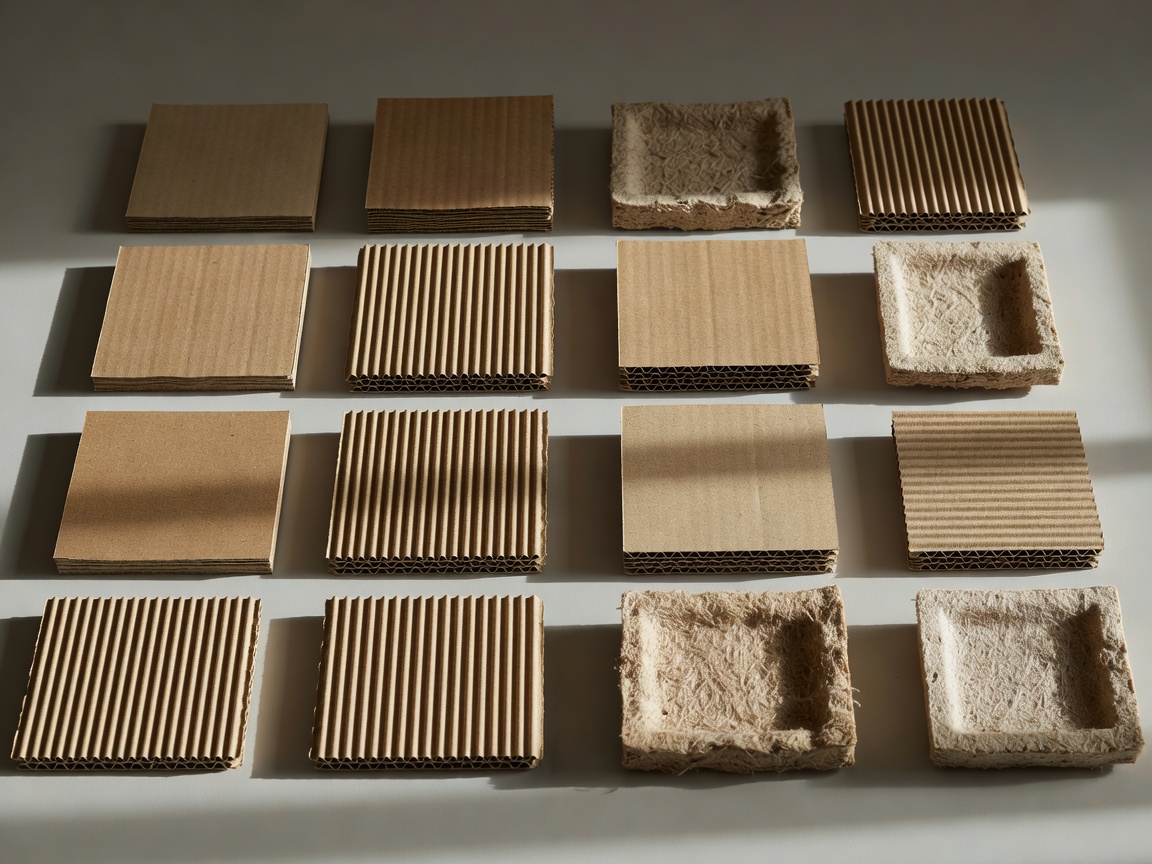
For paperboard and corrugated structures, discuss grade, grammage, caliper, flute construction, fibre direction and appropriate strength properties with the supplier. These are related but not interchangeable descriptors. A thicker board is not automatically a better protective system, and a render cannot establish which direction a score will fold reliably.
For polymer structures, define the resin or multilayer construction, thickness, relevant barrier properties and conversion process. Include seal requirements where applicable. For moulded fibre, examine density variation, draft angles, surface abrasion and dimensional repeatability. In every case, specify coatings, inks, adhesives and surface treatments as part of the pack rather than treating them as insignificant finishing details.
Review inserts as working components
A protective insert must locate the product and manage loads without creating new damage points. Ask where the product is supported, what movement remains possible and how much variation the geometry can tolerate. An insert that performs with one hand-built sample may grip too tightly or too loosely across production tolerances. Product variation belongs in the same discussion as packaging variation.
Prototype the handling sequence as well as the fitted state. Can an operator load the product without forcing it? Can the user remove it without pulling a fragile feature? Are separate pieces easy to identify and dispose of? Early physical mock-ups can reveal these problems before expensive tooling, even though mock-up materials may not reproduce final protective performance.
“A recyclable, fibre-based alternative.”
Questions still openWhat is the complete composition? What collection and sorting system exists in the intended market? Has the relevant construction been assessed, and does the claim describe the whole pack or one component?
Make environmental comparisons specific
Do not equate renewable content, recycled content, recyclability, compostability and lower environmental impact. They describe different attributes. A change can improve one while worsening another. Reducing packaging mass may also increase product loss or require a different transport configuration. Establish the functional requirement and system boundary before drawing a conclusion.
ISO 14040 and ISO 14044 provide a framework and requirements for life cycle assessment. ISO 14021 addresses self-declared environmental claims. EN 13432 concerns packaging recoverable through composting and biodegradation under specified conditions; it does not mean that an item will disappear in the open environment or be accepted by every collection scheme. Ask a qualified specialist to interpret applicability and current editions.
FSC and PEFC certification can support particular forest-sourcing claims within their respective chain-of-custody systems. They do not, by themselves, prove recyclability, lower total environmental impact or packaging performance. Verify certificates, claim scope and permitted wording through the relevant scheme rather than copying a logo from an AI-generated concept.
Use AI to expose missing information
A language model can help turn a supplier data sheet into a list of follow-up questions, provided confidential information is handled appropriately. It can also help maintain a comparison template. Require it to distinguish quoted information from inferred properties and absent data. Check every technical value against the original document; fluent summaries can accidentally remove test conditions or units.
Do not allow an AI tool to fill empty cells with apparently typical values and then rank materials as if those values were measured. Use “not supplied” or “not yet tested” where that is the truth. If assumptions are necessary for early exploration, label them, examine sensitivity and prevent them from being reused as procurement specifications.
Advance with a controlled sample
The material review should end with a defined sample construction, supplier reference, unresolved risks and a physical evaluation plan. Retain a labelled sample and associated documentation so later comparisons refer to the same thing. A promising material story is worth exploring; it becomes a production choice only after its specific construction has earned that decision.
| Component | Request | Do not infer from appearance |
|---|---|---|
| Folding carton | Grade, caliper, fibre direction, coating and converting advice | Crease quality or compression performance |
| Protective insert | Construction, dimensional limits and test samples | Shock attenuation or product compatibility |
| Barrier layer | Property data, conditions and contact-use documentation | Shelf-life suitability or local recovery route |
Reference starting points: ISO, CEN-CENELEC, FSC and PEFC. This guide is not material certification or legal advice.